
Mathematics can be challenging, especially when dealing with complex equations involving algebra, calculus, trigonometry, or logarithms. An equation solver with steps is a valuable learning tool that not only provides the final answer but also explains each stage of the solution process. Instead of simply giving the result, it helps students understand how the answer is derived, making it an excellent study companion.
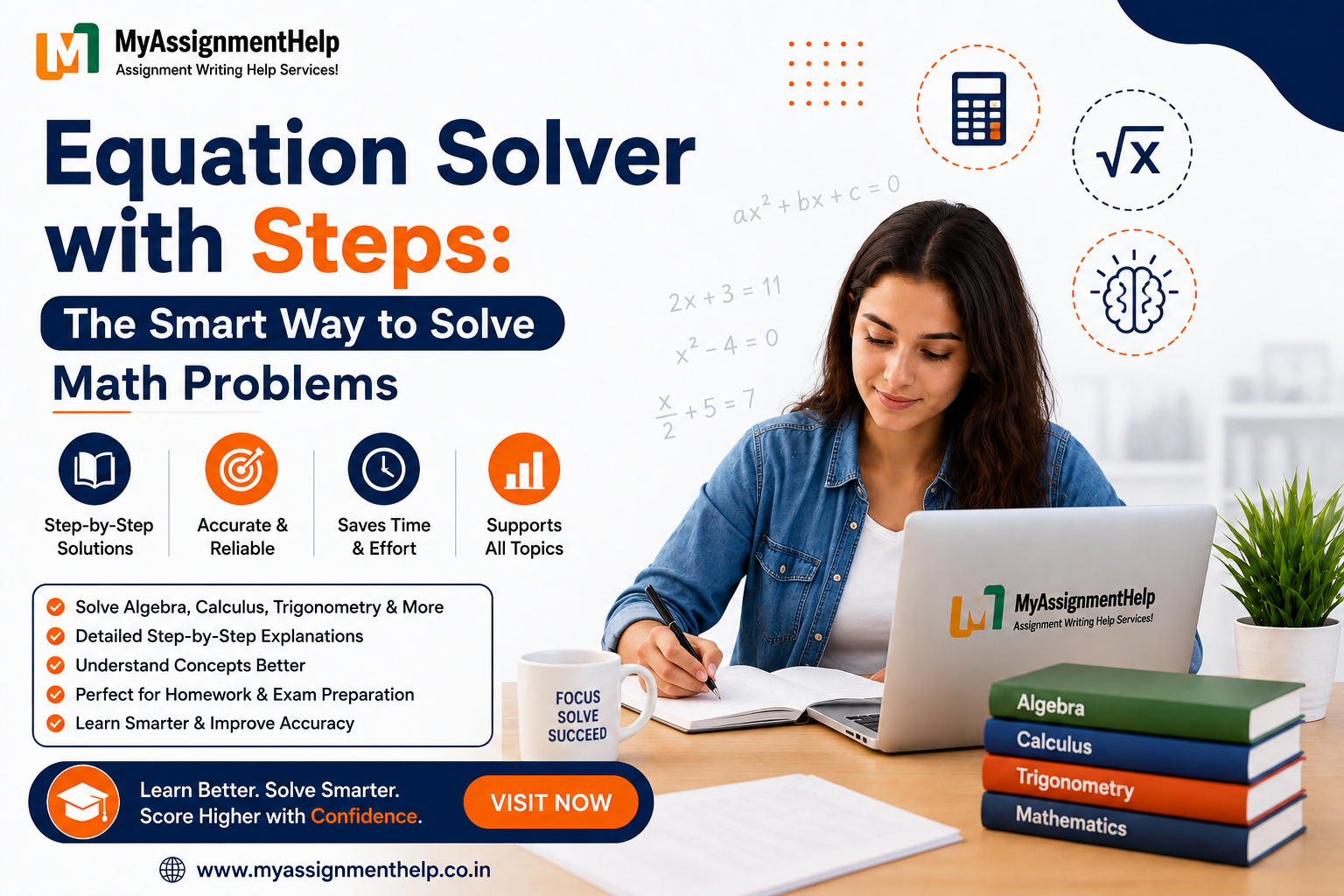
Whether you’re in high school, college, or university, using an equation solver can improve your problem-solving skills, boost your confidence, and save valuable time on assignments and exam preparation.
What Is an Equation Solver with Steps?
An equation solver with steps is an online tool that solves mathematical equations while displaying each calculation involved. It breaks down the solution into manageable steps so students can follow the logic behind the answer rather than memorizing formulas.
These tools are particularly useful for solving:
- Linear equations
- Quadratic equations
- Polynomial equations
- Simultaneous equations
- Exponential and logarithmic equations
- Trigonometric equations
- Calculus-based equations
- Differential equations
By understanding every step, students develop stronger mathematical concepts and reduce common calculation errors.
Why Students Use Equation Solvers
Students often face multiple assignments, quizzes, and exams simultaneously. Solving lengthy equations manually can consume a significant amount of time.
An equation solver helps students:
- Learn step-by-step methods
- Verify homework answers
- Practice different solving techniques
- Save time during revision
- Build confidence before exams
- Reduce calculation mistakes
Rather than replacing learning, a quality equation solver supports it by providing detailed explanations that reinforce classroom concepts.
Benefits of Using an Equation Solver with Steps
Better Concept Understanding
Unlike ordinary calculators, equation solvers explain every mathematical operation. This helps students understand formulas, transformations, and solving techniques.
Saves Time
Complicated equations that may take several minutes manually can often be solved within seconds, allowing students to focus on learning instead of repetitive calculations.
Improves Accuracy
Human errors are common during lengthy calculations. Equation solvers minimize mistakes by following accurate mathematical procedures.
Supports Independent Learning
Students can study at their own pace, review each solution, and revisit difficult concepts whenever needed.
Useful for Assignment Preparation
When working on homework, students can compare their own solutions with the step-by-step explanations to identify mistakes and improve future performance.
Types of Equations You Can Solve
Modern equation solvers support a wide variety of mathematical problems.
Linear Equations
Linear equations involve variables with powers of one.
Example:
2x + 5 = 15
The solver isolates the variable and explains every transformation.
Quadratic Equations
Quadratic equations involve squared variables and are solved using factorization, completing the square, or the quadratic formula.
Polynomial Equations
Higher-degree equations require advanced solving techniques that equation solvers explain clearly.
Trigonometric Equations
These involve sine, cosine, tangent, and other trigonometric functions commonly studied in higher mathematics.
Logarithmic and Exponential Equations
Students often struggle with logarithmic identities. Step-by-step solutions make these topics much easier to understand.
How an Equation Solver Works
Most equation solvers follow a systematic process:
- Read the mathematical expression.
- Identify the equation type.
- Apply the appropriate solving method.
- Simplify each mathematical operation.
- Display every intermediate step.
- Present the final answer.
This logical sequence makes it easier for students to follow the reasoning behind each calculation.
Common Features of Good Equation Solvers
A reliable equation solver should include:
- Step-by-step explanations
- Support for multiple equation types
- Instant calculations
- Graphical representation (where applicable)
- Easy-to-use interface
- Mobile compatibility
- Accurate mathematical algorithms
These features create a more interactive and engaging learning experience.
Tips for Using Equation Solvers Effectively
To maximize learning, students should avoid copying answers directly. Instead:
- Attempt the problem first.
- Compare your work with the solver’s solution.
- Identify where mistakes occurred.
- Understand each calculation before moving to the next question.
- Practice similar problems independently.
Using equation solvers as learning tools rather than shortcuts leads to better academic performance.
When Should You Seek Additional Academic Help?
While equation solvers are excellent for practice, some assignments require detailed explanations, mathematical proofs, or custom problem-solving approaches that go beyond automated tools.
This is where academic experts can make a significant difference. MyAssignmentHelp.co.in provides professional mathematics assignment assistance, helping students understand difficult concepts, complete assignments accurately, and improve overall academic performance. Their experienced subject specialists offer personalized guidance across various branches of mathematics.
Final Thoughts
An equation solver with steps is much more than a calculator—it is a learning companion that helps students understand mathematical concepts through detailed explanations. By breaking down complex equations into easy-to-follow steps, these tools improve accuracy, enhance confidence, and support independent learning.
For students who require additional academic assistance with challenging mathematics assignments, MyAssignmentHelp.co.in offers expert support to complement self-study and help achieve better grades. Combining an equation solver with professional academic guidance is an effective way to strengthen mathematical skills and excel in coursework.


