
When studying neuroscience, one important concept is how neurons combine incoming signals before deciding whether to generate an action potential. Temporal summation and spatial summation are two mechanisms that allow postsynaptic potentials to combine. Although both help neurons integrate information, they differ mainly in timing and the number or location of inputs involved.
What Is Temporal Summation?
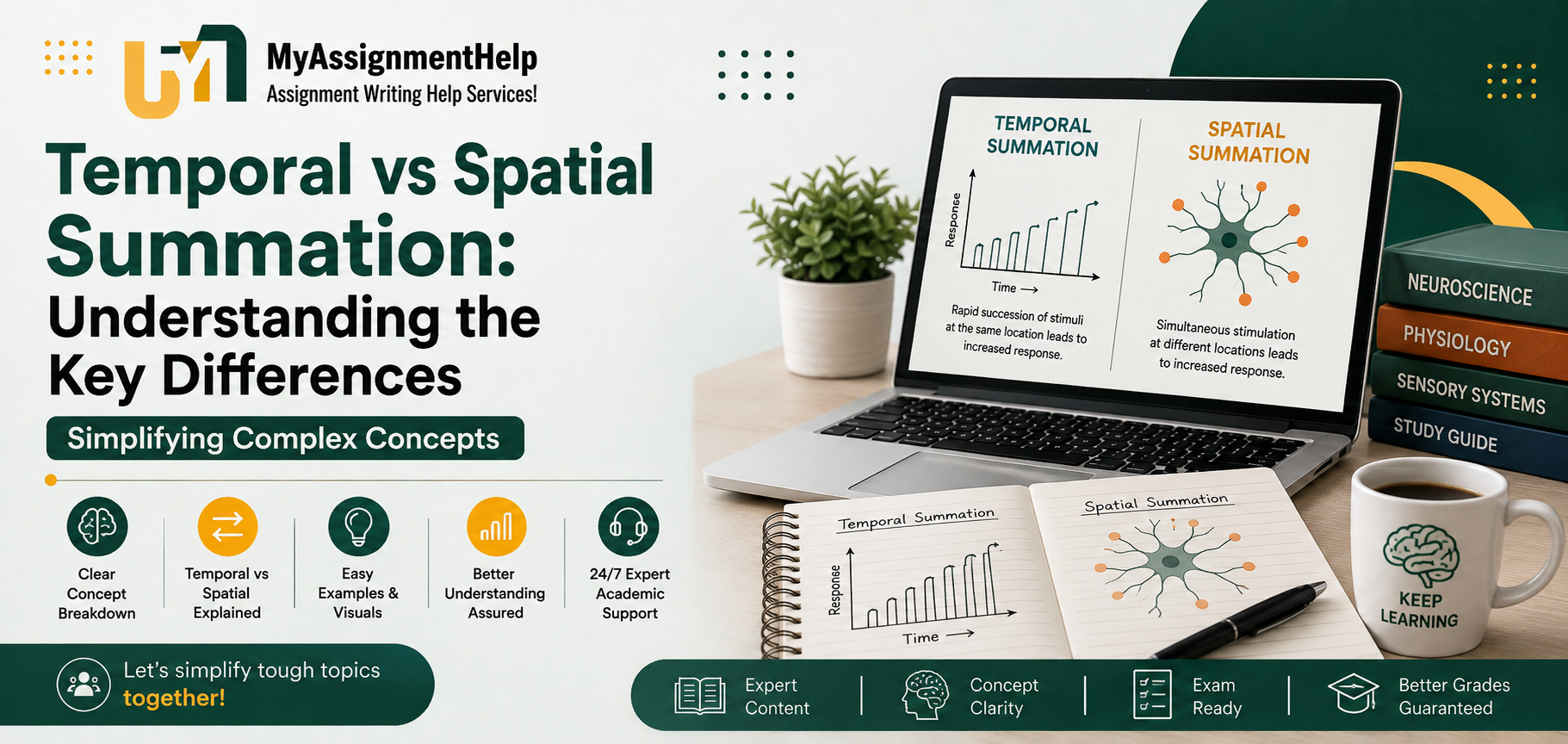
Temporal summation occurs when a single presynaptic neuron repeatedly sends signals in rapid succession to the same postsynaptic neuron. If the next signal arrives before the previous postsynaptic potential has completely disappeared, the effects can add together. A sufficiently rapid series of excitatory postsynaptic potentials (EPSPs) may depolarize the membrane enough to reach the threshold for an action potential.
For example, imagine one neuron sending several signals to another neuron within a short period. Each individual signal may be too weak to trigger an action potential. However, because the signals arrive close together in time, their effects accumulate. This is why temporal summation is strongly associated with the frequency of incoming stimulation.
What Is Spatial Summation?
Spatial summation occurs when signals from multiple presynaptic neurons or synapses reach a postsynaptic neuron at approximately the same time. The individual postsynaptic potentials combine as they travel toward the neuron’s trigger zone. If their combined effect reaches the required threshold, an action potential can be generated.
For instance, several neurons may simultaneously provide excitatory input to different synapses on one neuron. While one input may not be strong enough to produce an action potential, the combined effect of several inputs can produce sufficient depolarization.
Temporal vs Spatial Summation
| Feature | Temporal Summation | Spatial Summation |
|---|---|---|
| Main factor | Time | Location/number of inputs |
| Signal source | Usually one presynaptic input firing repeatedly | Multiple presynaptic inputs |
| Timing | Signals arrive rapidly one after another | Signals arrive at approximately the same time |
| Key factor | Frequency of stimulation | Number and distribution of active synapses |
| Main effect | Builds a potential over time | Combines potentials from different locations |
Both mechanisms ultimately help the neuron integrate excitatory and inhibitory signals. Their combined effects are evaluated near the axon hillock/initial segment, where the neuron determines whether the membrane potential reaches the threshold required for an action potential.
Why Are Temporal and Spatial Summation Important?
Neurons constantly receive information from many sources. A single synaptic input is often insufficient to reach the threshold for firing. Summation allows the nervous system to integrate these smaller signals and produce an appropriate response.
Temporal summation helps neurons respond to repeated stimulation over a short period, whereas spatial summation helps them combine simultaneous inputs from different locations. In real neural networks, both processes can operate together, allowing neurons to make complex decisions based on the timing and distribution of incoming signals.
How to Remember the Difference
A simple way to remember the distinction is:
- Temporal = Time: repeated signals from an input accumulate over time.
- Spatial = Space: signals arriving from different synaptic locations combine.
Understanding temporal vs spatial summation online can make topics such as synaptic transmission, graded potentials, EPSPs, IPSPs, and action potential generation easier to understand. Students looking for additional academic guidance can also explore subject-focused learning resources and assignment support from MyAssignmentHelp.co.in.
Conclusion
Temporal and spatial summation are essential mechanisms of neuronal integration. Temporal summation depends primarily on the rapid repetition of signals, while spatial summation depends on the combined influence of signals arriving at different synapses. Learning this distinction provides a strong foundation for understanding how neurons process information and regulate action potential generation.


